Platon

Abstract: The Art of Design

I’m not really a photographer at all. The camera is nothing more than a tool. Communication, simplicity, shapes on a page. What’s important is the story, the message, the feeling, the connection. How do you make this reach people? It’s a combination of graphic simplicity and the power of spirit and soul. It’s design.

– Platon

I have been captivated by these Abstract documentaries on Netflix for some time now. Since they appeared on Netflix in 2017, I have watched all 16 episodes across the two seasons. Four of the episodes, in particular, I have probably watched numerous times—too embarrassed to say exactly how many. Let’s just say I’ve watched them a lot. They are family to me.

Platon has influenced my storytelling by opening a door that was closed back in the 90’s. I cut my teeth with storytelling shooting 35mm film and creating slide shows through the medium of Multi-Image.

Wikipedia defines Multi-image as follows:

Multi-image is the now largely obsolete practice and business of using 35mm slides (diapositives) projected by single or multiple slide projectors onto one or more screens in synchronization with an audio voice-over or music track. Multi-image productions are also known as multi-image slide presentations, slide shows and diaporamas and are a specific form of multimedia or audio-visual production.

Well, that hurt. I don’t care about your diaporamas anyway, Wikipedia.

Platon rekindled my love for still photography and its power. A still photograph has a visual power all its own. Video certainly has its place, but a still image has magic.

Head over to Netflix and watch Platon’s episode. Be inspired!
Emma Coats 22 basics of storytelling

Where else would you go to get the basics of storytelling other than Pixar. Here are Emma’s:

22 Story Basics

#1: You admire a character for trying more than for their successes.

#2: You gotta keep in mind what’s interesting to you as an audience, not what’s fun to do as a writer. They can be very different.

#3: Trying for theme is important, but you won’t see what the story is actually about ’til you’re at the end of it. Now rewrite.

#4: Once upon a time there was _____. Every day, _____. One day _____. Because of that, _____. Because of that, _____. Until finally _____.

#5: Simplify. Focus. Combine characters.  Hop over detours. You’ll feel like you’re losing valuable stuff but it sets you free.

#6: What is your character good at, comfortable with? Throw the polar opposite at them. Challenge them. How do they deal?

#7: Come up with your ending before you figure out your middle. Seriously. Endings are hard, get yours working up front.

#8: Finish your story, let go even if it’s not perfect. In an ideal world you have both, but move on. Do better next time.

#9: When you’re stuck, make a list of what WOULDN’T happen next. Lots of times the material to get you unstuck will show up.

#10: Pull apart the stories you like. What you like in them is a part of you; you’ve got to recognize it before you can use it.

#11: Putting it on paper lets you start fixing it. If it stays in your head, a perfect idea, you’ll never share it with anyone.

#12: Discount the 1st thing that comes to mind. And the 2nd, 3rd, 4th, 5th — get the obvious out of the way. Surprise yourself.

#13: Give your characters opinions. Passive/malleable might seem likeable to you as you write, but it’s poison to the audience.

#14: Why must you tell THIS story? What’s the belief burning within you that your story feeds off of? That’s the heart of it.

#15: If you were your character, in this situation, how would you feel? Honesty lends credibility to unbelievable situations.

#16: What are the stakes? Give us reason to root for the character. What happens if they don’t succeed? Stack the odds against.

#17: No work is ever wasted. If it’s not working, let go and move on – it’ll come back around to be useful later.

#18: you have to know yourself: the difference between doing your best & fussing. Story is testing, not refining.

#19: Coincidences to get characters into trouble are great; coincidences to get them out of it are cheating.

#20: Exercise: take the building blocks of a movie you dislike. how d’you rearrange them into what you DO like?

#21: You gotta identify with your situation and characters – you can’t just write ‘cool’. What would make YOU act that way?

#22: What’s the essence of your story? Most economical telling of it? If you know that, you can build out from there.


Napoleon Dynamite on storytelling

We didn’t have the money for aerial shots or big expansive night shots. We chose to shoot wide-angle close-ups and just kind of make it goofy. Everything was locked in the shot; it was a very still film. What’s nice about that static camera is that the little nuances come shining through. If Kip and Napoleon do a little flinch or some little head droop, you always felt it. What made it sing were the performances. – Munn K. Powell cinematographer

I have to admit that my kids influenced my choice to watch Napoleon Dynamite. They had already seen it and were quoting lines imitating Napoleon. You’re trapped when your kids quote lines to each other and spontaneously explode into laughter. So reluctantly, I watched it. And watched it again. And watched it again. “Tina, you fat lard, come get some dinner!”

Not knowing it at the time, this movie would influence the final stages of my producing career more than any other. In what way? Two words, “static camera.” This quote from Munn Powell expresses it best:

What’s nice about that static camera is that the little nuances come shining through.

That “static camera” allows the audience to enjoy the moment’s authenticity. If you’ve done your homework and captured a good interview, these “static camera” moments will make the interview sing.

In my experience, locking off my camera and watching the action float in and out of the frame is a tad disarming. You think, “What if the action isn’t compelling?” Then I hear Napoleon, “I see you’re drinking 1%. Is that ’cause you think you’re fat? ‘Cause you’re not. You could be drinking whole if you wanted to.” My kids got that.

I produced Side Track Coffee in this fashion. Did my homework and captured the interview. Used “static camera” shots to support the story. The result, “little nuances come shining through.”

“It’s Still Dynamite” was a great read on looking back on the making of Napoleon Dynamite after all these years. Check it out!

“Why is everyone talking about this?”

Such a simple, powerful question. Preparing for interviews is often, well, always overlooked in the storytelling production process. Not for me.

Question: Would you build a house or do a remodel without an architect preparing a plan? If your answer was yes, then you don’t need to read further.

For those who are still reading, I frequently try to glean wisdom from experienced reporters, if they are willing to divulge it.

I read The Art of Crafting Effective Interview Questions by Emily Laber-Warren. Emily writes about heady science topics I can’t pronounce. For me, this is a good place to start.

Here are Emily’s bullet points and a few good quotes from others:

Let the Story Shape Your Questions

One of Hirji’s favorite questions is simply: “Why is everyone talking about this?” “You don’t want to spend so much time trying to sound smart about something,” she says, “when actually you just need to ask it in the [most plain], stripped-down way.”

Craft Your First Question with Care

Give special thought to the first question you pose. You may be tempted to start an interview slow and build up to the important questions. Don’t. Try crafting a starter question that helps the source warm up to the conversation, but make it count. You never know when an interview may get cut off unexpectedly, Hirji says.

Use Your Angle to Stay on Track

An interview is a process of discovery, and the best material will sometimes be stuff you had no clue about before the conversation began.

Improvise Follow-Up Questions to Go Deeper

No matter how carefully you craft your prepared questions, when the conversation starts you need to be ready to come up with questions on the fly. An interview is a process of discovery, and the best material will sometimes be stuff you had no clue about before the conversation began. “Sometimes you get your best quote or your best facts from a question that wasn’t prepared,” Hirji says.

Excellent article, Emily. Thanks for passing this along

How to tell a great story

Surprisingly, the fewer details a marketer spells out, the more powerful the story becomes. Talented marketers understand that allowing people to draw their own conclusions is far more effective than announcing the punch line.

Seth Godin’s breakdown of “How to tell a great story” on his blog is well-written and certainly worth remembering.

Here are the 11 points broken down for quick reference.

  1. Great stories succeed because they are able to capture the imagination of large or important audiences.
  2. A great story is true
  3. Great stories make a promise
  4. Great stories are trusted
  5. Great stories are subtle
  6. Great stories happen fast
  7. Great stories don’t always need eight-page color brochures or a face-to-face meeting.
  8. Great stories don’t appeal to logic, but they often appeal to our senses.
  9. Great stories are rarely aimed at everyone.
  10. Great stories don’t contradict themselves.
  11. Most of all, great stories agree with our worldview.

Now, go read Seth!

X100V storytelling tool?

Since Fuji released its X100 series in 2011, it has gained a significant following. I have enjoyed two iterations of this camera line, and I currently own the X100V. While its main purpose is as a still camera, its video capabilities are surprisingly impressive. I decided to explore who is making the most of these features and came across “barparildar.”

I watched his first video unfolding the capabilities of the X100V. I was impressed that this compact camera had some game!

This also caught my attention in his about me:

I am a minimalist filmmaker/photographer who likes to be in nature. I believe in light and composition… Everything else is background noise to me.

Well done.

Business Wisdom Told Here

I’m a sucker for a well-told story. Add in how a successful business navigates the treacherous waters to survive and actually, ok, tell the story. That’s stuff worth passing along to others. The folks at Basecamp created them:

Basecamp spent three years telling the stories of people who run businesses that endured 25 years or more. Have a listen — they’re an inspiration for anyone looking to build a business that goes the distance.

Wailin Wong is the reporter that guides you through these stories. She is well researched, thoughtful, and a colorful storyteller. She brings the goods.Image result for waylan wong the distance

Here are a few of my personal favorites:

Rainbow Connection

Going to the Mattresses

Grateful Heads

Always Glad You Came

Make It Rain

Auto Transmission

World’s Largest Laundromat

Enjoy!

Capture usable interviews using your iPhone

You carry a fantastic storytelling tool on your person every single day. So let’s arm you with a few technical and practical interviewing tips to capture amazing impromptu interviews.

Camera Settings

  1. No digital zoom – shoot in the widest zoom setting that your phone has. When you zoom in you lose out on all that pixel goodness that Apple has given you.
  2. Exposure/focus lock – Use exposure and focus lock to keep your phone from searching and focusing on other details within the frame during the interview.
  3. Airplane mode – Engage airplane mode before you hit the record button. Sucks to get calls or texts during an interview.

Recording

  1. Horizontal – Only shoot horizontal or “landscape.” Vertical video is not useable. When we have verticle televisions, I will redo this post.
  2. Steady Eddie – Hold the camera steady and at your subjects eye level or slightly above.
  3. Rule of thirds – Here is a good video on overall composition https://www.youtube.com/watch?v=iWQQgZh9EyE
  4. Handles – Let each of your shots have a little extra time at the start and end. It will give the editor more possibilities in the edit. Handles.

Lighting

  1. Indoors – If you’re shooting indoors, position your subject facing a window and use the sun.
  2. Outdoors – Look for a light-colored wall that you can use as a giant bounce card for your subject.
  3. Shade – Harsh overhead lighting is not flattering. Look for a shaded area to place your subject.

Audio

  1. Close – Pull your subject as close to the camera as possible (without looking like your up their nose). Your audio will sound so much better.
  2. “Show me the money” – Do not try to hide distracting background sounds. Position your subject so your audience can see the noise in the background. It becomes a part of your story.
  3. Rest assured, as soon as you begin shooting all leaf blowers will start along with you.

Performing the interview

  1. Three minutes max – Do not shoot for over 3 minutes per question. Your arms will get tired holding that iPhone up. In between questions, let your arms rest.
  2. Asking for help – If possible, enlist someone to ask your questions just off of your shoulder as you hold the iPhone. Your subject will be more comfortable talking to a person rather than a phone.

In the end, a compelling interview happens because we are interested in a person and their story. Plus, a little homework before hitting the record button can undoubtedly help. That’s for another post.

Factual Romance

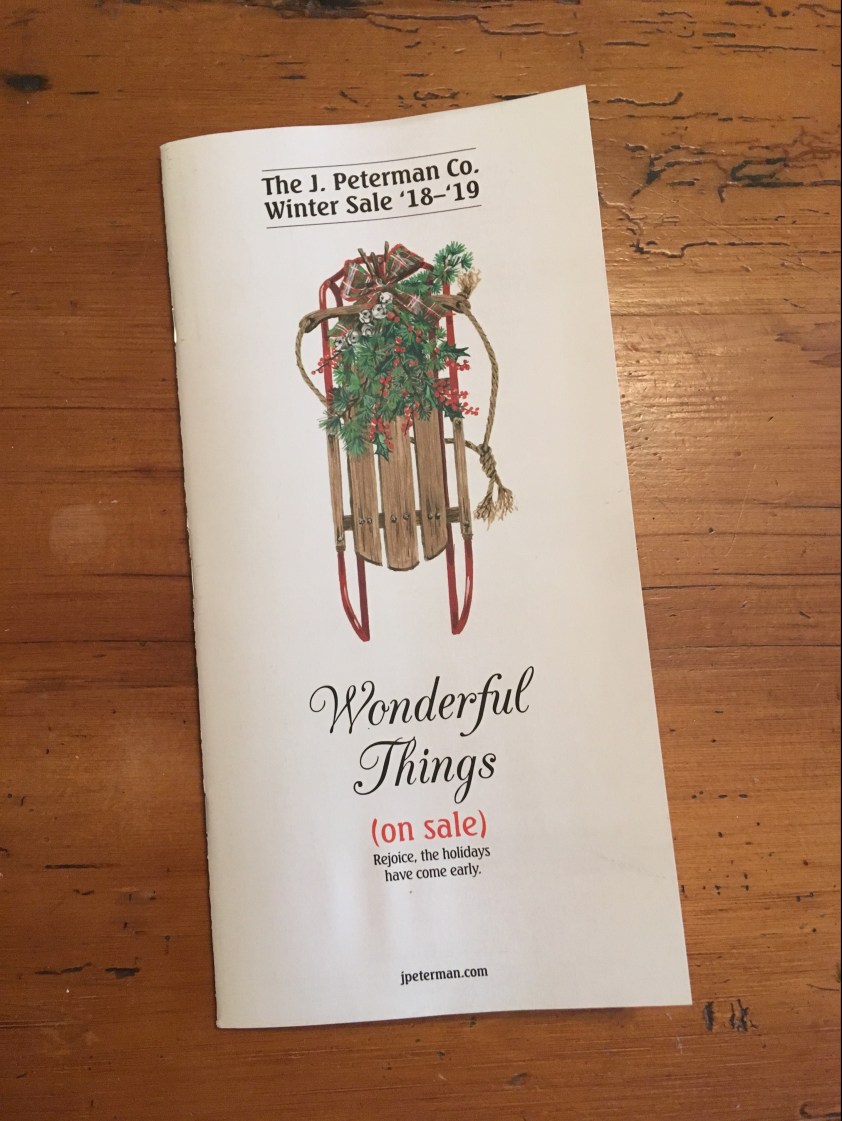
I love being romanced. The J. Peterman Co. knows how to sweep me off my feet. I always look through their catalog when it arrives in my mailbox.

IMG_0369.jpgEvery item in the catalog has a story. As it should be. I opened to the first page and I saw their Philosophy. Oh my, good stuff.

Philosophy

“People want things that are hard to find. Things that have romance, but a factual romance, about them.

I had this proven to me all over again when people actually stopped me in the street (in New York, in Tokyo, in London) to ask me where I got the coat I was wearing.

So many people tried to buy my coat off my back that I started a small company to make them available.

I ran a little ad in The New Yorker and The Wall Street Journal and in a few months sold this wonderful coat in cities all over the country and to celebrities and to a mysterious gentleman in Japan who ordered two thousand of them.

I think the giant corporations should start asking themselves if the things they make are really, I mean really, better than ordinary.

Clearly, people want things that make their lives the way they wish they were.”

J. Peterman

Factual romance